The Lenten Fast
I invite you, therefore, in the name of the Church, to the observance of a holy Lent: by self-examination and repentance; by prayer, fasting, and alms-giving; and by reading and meditating on God’s holy Word.
- p. 544 from “Ash Wednesday” in The Book of Common Prayer (2019)
Since our prayer book invites us to keep a holy Lent and specifically mentions fasting, let’s consider the Why, How, What, When, and Who of fasting as Anglicans.

Flandes, Jesus and the Tempter (c. 1500)
The Why
Fasting has three primary ends:
self-control, bringing the flesh in subjection to the spirit
prayer, increasing its fervency and earnestness
repentance, as an aid and as a testimony to God
Often a fourth reason is included: to increase our alms. And at least one author mentions that fasting helps us to receive God’s word rightly.
The How
Fasting is not good in itself, and it can be done unto a good or bad end. The bad end is most commonly pride, thus Jesus teaches us not to fast to be seen by others (Matthew 6:6-18). So it’s best to limit how much you talk about your fast. The good ends of fasting are the three (or more) “Why’s” of fasting listed above. Ultimately, the outward fast from food should always be accompanied by an inward “fast” from sin. In order to focus your heart on the spiritual ends of your fast, it’s probably best to err on the side of simplicity, especially if you are new to fasting.
The What
Fasting in its literal sense has to do with eating more modestly, whether in terms of the quantity or the quality of food eaten. There are two kinds of fasts in the Bible we can imitate: the fast of Daniel and the fast of David. (The fasts of Moses, Elijah, and Jesus are not recommended.)
Daniel’s Fast: The prophet Daniel’s fast does not indicate any time restriction, but only that he ate no delicacies, meat, or wine for three weeks while in mourning (Daniel 10:2-3). It should be assumed that Daniel generally limited how much he ate. Daniel’s fast can be pithily summarized as: “No meat, no sweet, don’t overeat.” Alcohol, too, should certainly be limited, if not abstained from fully, as well. (While the terms “fasting” and “abstinence” are often used interchangeably, the Daniel kind of fasting is sometimes described as “abstinence,” which can be a helpful distinction.)
David’s Fast: The fast of David is more severe than that of Daniel. David ate nothing all day and presumably ate only a modest meal after sundown while mourning the death of Abner (2 Samuel 3:35; cf. 2 Sam 12:15-23). For our purposes, it’s best to assume that the evening meal should have the character of the Daniel Fast (i.e., “No meat, no sweet, don’t overeat”).
Having said all this, it can be helpful to give up things other than food for a season such as Lent. This can be done in addition to a food fast, or instead of one. Or it may be wise in your situation not to give up meat but to still give up sweets. Here are a few notes on different kinds of things you could give up.
A Modified Fast: There are plenty of reasons why not to fast (see the “Who” section below). If you discern that it’s best for you not to fast from all food or from meat, then consider fasting from all sweets. If you don’t think you can fast from all sweets, then try something specific like chocolate. Just beware of the tendency to replace chocolate with another kind of sweet that you end up eating more of.
A Lenten Discipline: A Lenten discipline is anything you remove or add to your life during the season of Lent. As a discipline, you might give up screen time during Lent because it tends to distract you from devotion or may be a regular occasion for sin.
Giving up a sin: Don’t wait for Lent, and don’t start back at Easter! Repent now and forever! By all means, make a special effort during Lent to conquer any sin that plagues you, but do not think of it as a Lenten fast.
The When
The Forty Days of Lent are the “weekdays” (including Saturday) from Ash Wednesday to Holy Saturday of Holy Week. Sundays are always feasts so they don’t count as the 40 Days of Lent and you are not to fast on them. Having said that, it may be a good idea to keep your Lenten discipline on Sundays, if you have one.
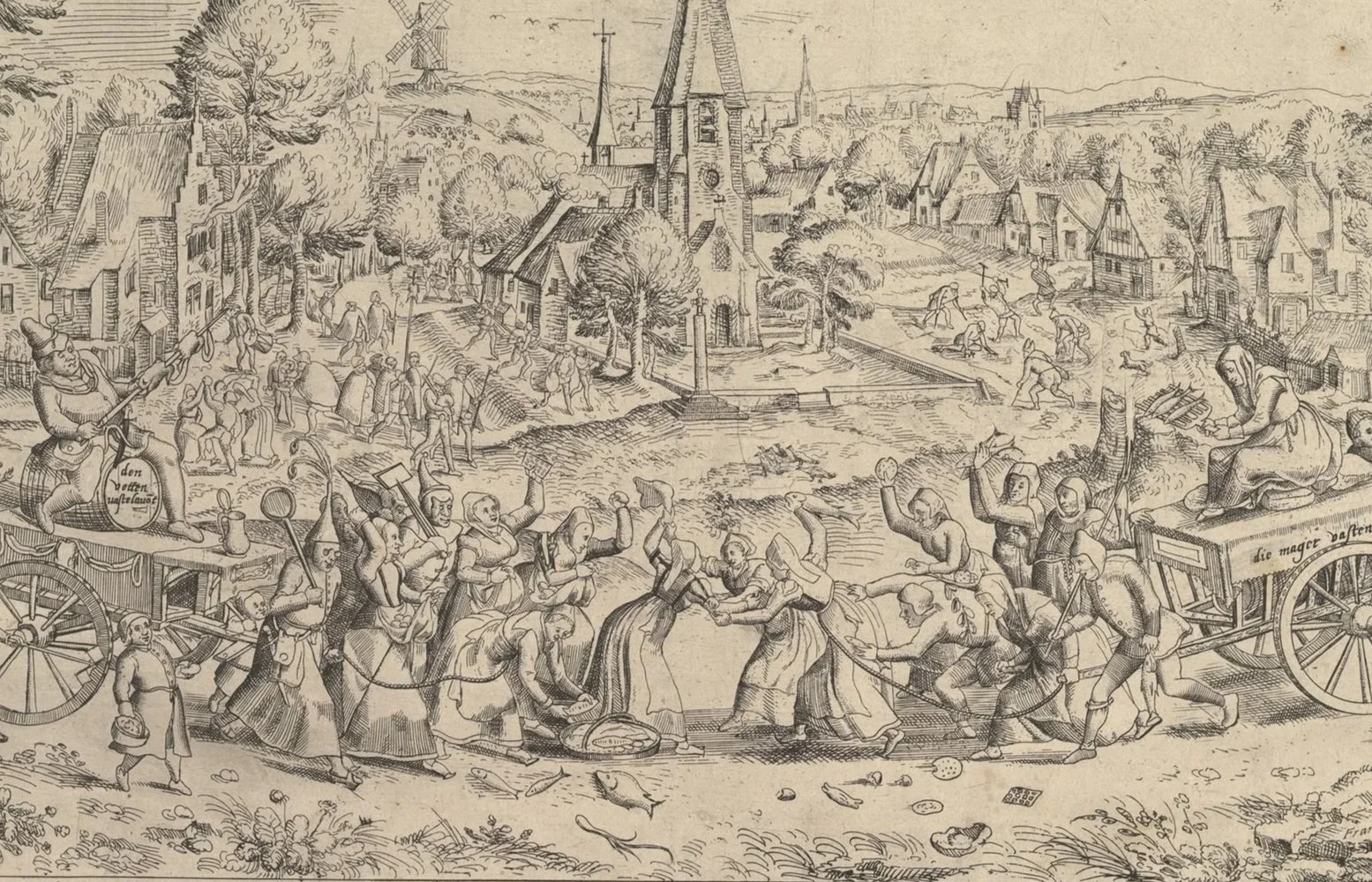
From Hogenberg’s Lent and Carnival (1558)
Now let’s apply the “What” to the “When,” starting with some historical context. In the early centuries of the church, it was common to not eat at all until sundown during Lent, and then to eat very plain foods like bread and vegetables. This is often called a “Black Fast” and is akin to the fast of David which I described above. In medieval England, they fasted from animal flesh as well as animal products such as dairy and eggs. Thus the need to eat up all the pancakes on Shrove Tuesday. In the English Reformation, the rules were relaxed down to abstinence from meat, or what they called “flesh.” (Reading the historical primary sources on fasting can be confusing since they used “flesh” for what we today call “meat,” and they said “meat” to indicate food generally.)
Fish was not considered “flesh.” In fact, the days where “flesh” was prohibited were called “fish days" in England. On these days, fasting basically looked like the fast of Daniel described above. The Forty Days of Lent were all fish days. The stricter “David fast” of waiting until sundown to eat was reserved for the vigil (i.e., day before) of most major feasts.
Our Book of Common Prayer (2019) says this about fasting: “Ash Wednesday, the first day of Lent, and Good Friday, the day of our Lord’s Crucifixion, are traditionally days of special devotion and total abstinence. … The weekdays of Lent and every Friday of the year (outside the 12 Days of Christmas and the 50 days of Eastertide) are encouraged as days of fasting. Ember Days and Rogation Days may also be kept in this way” [italics mine] (pg 689). As you may have picked up, over time the tendency has been for things to relax, and things are quite relaxed today. Whereas older prayer books included a section called “Tables and Rules for Feasts and Fasts,” our prayer book does not give us rules as much as it informs us of what is “traditional” and what is “encouraged.”
If you are feeling encouraged about fasting from meat (meaning animal flesh), but 40 days sounds like a lot, then start with fewer days this year. A first step would be to fast on Ash Wednesday and Good Friday. If you want to do a little more, then fast on the Fridays of Lent. Next would be Wednesdays. Then all forty days.
The Who
This is a really important caveat: fasting is not for everyone. The elderly, the sick, pregnant and nursing women, children, soldiers, and laborers all have legitimate cause to modify their fast or not fast at all.
What Will You Do?
Here’s a table that’s half silly, half helpful (hopefully). Check it out, have a smile, and make a plan for this year’s Lent. If it’s your first Lent, start with the “Lenten Newbie.” If you’ve done that sort of thing in years past, then try the “Conscientious Abstainer.” There’s no reason to go beyond “The Anglican Classic”—the rest are just for fun. Unless you have past experience eating a meatless diet, I would recommend trying the “Frequent Faster” before “Anglican Classic.” There are a thousand variations you could make.
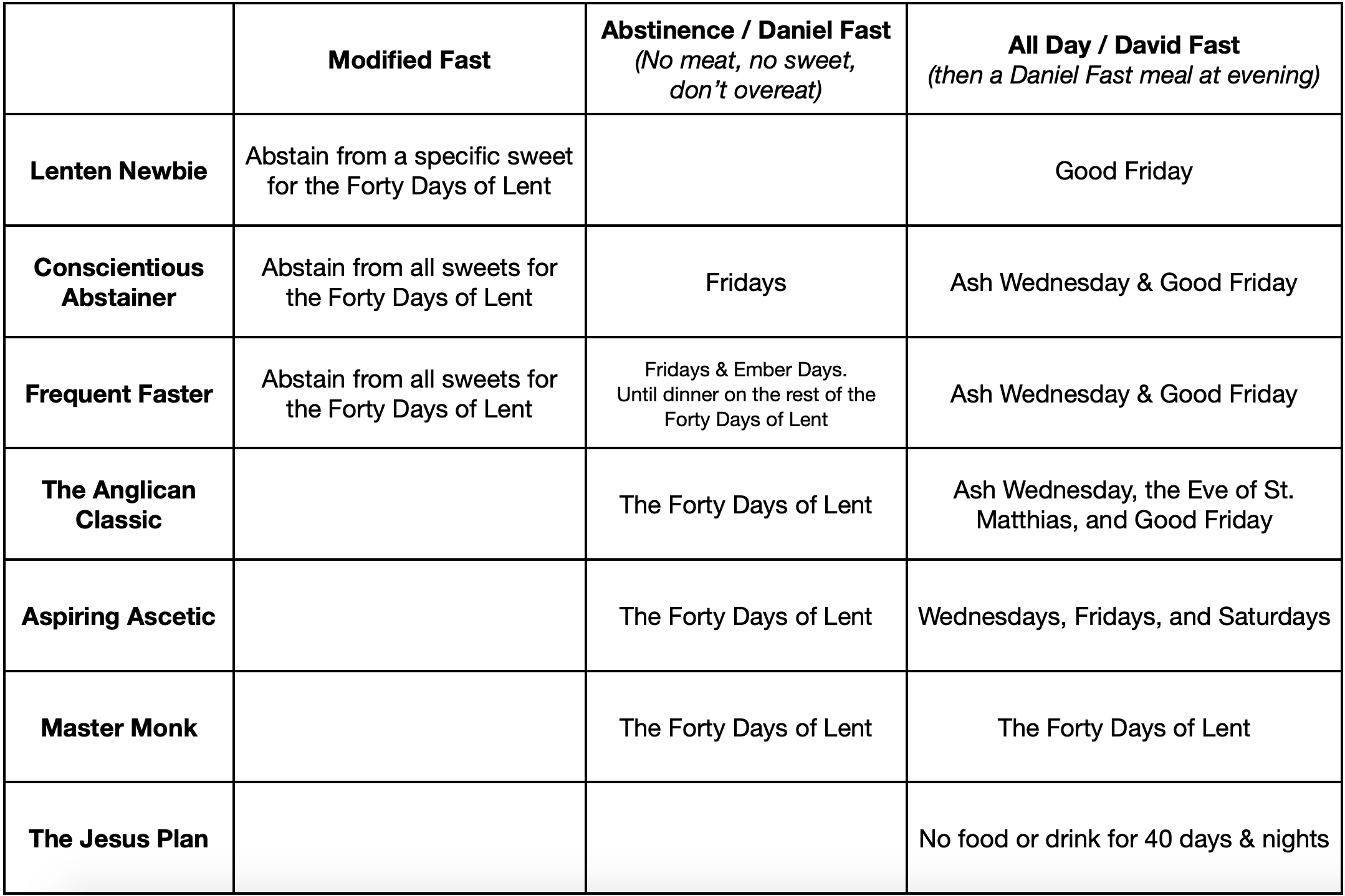
Remember to always come back to the “Why’s” of fasting and what the “Why’s” imply. Our flesh lusts after sinful pleasures. Distractions and anxieties weaken our prayers. We have sin in our life that we must repent from. We don’t fast to become saints. Christ has called us saints already. We fast because we are the sinners he has called to repentance.
My hope as your priest is not that we’d all fast, but that we’d all repent. I just think fasting will help.
FOR FURTHER READING ON FASTING:
Thomas Bacon: A Fruitful Treatise of Fasting (1551)
The Second Book of Homilies (1563): An Homily of Good Works: And First of Fasting, Part 1
Lancelot Andrewes: Ash Wednesday Sermon from 1619
Jeremy Taylor: Chapter IV, Section V: “Of Fasting” in Holy Living (1650)
John Cosin: Appendix, Chapters 2 & 3 in “The Religion, Discipline, and Rites of the Church of England” (1652)
“The Several Statutes in Force for the Observation of Lent” (1661)
E.B. Pusey: Thoughts on the Benefits of the System of Fasting, Enjoined by Our Church (1833)